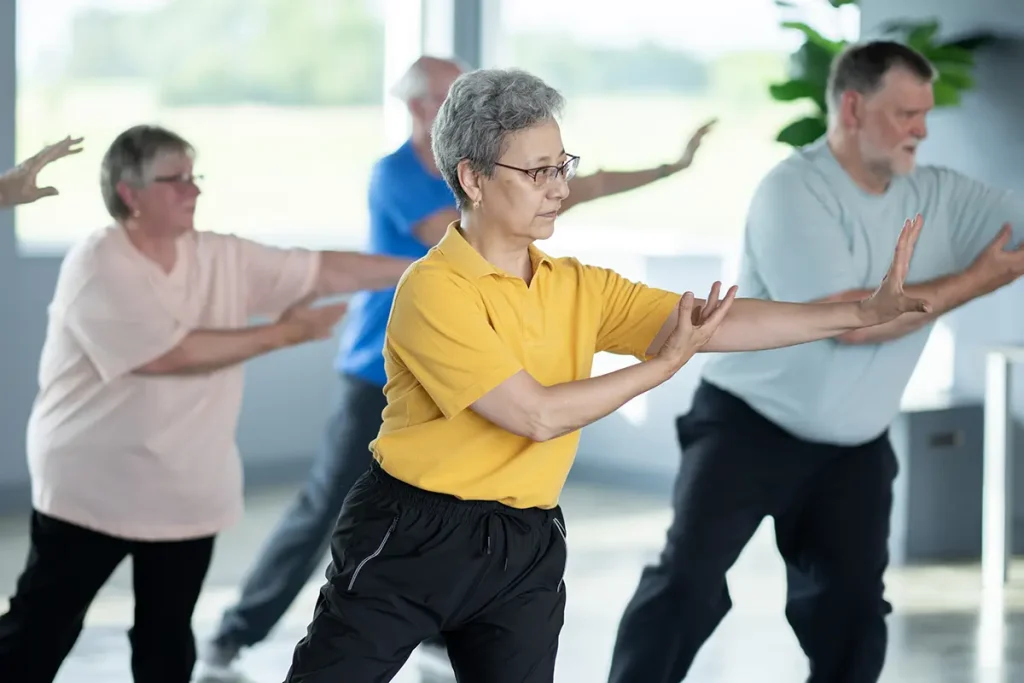
Tai Chi Classes in Oshawa and Whitby
Chathamson School of Tai Chi offers traditional Tai Chi classes in Oshawa and Whitby, focused on balance, relaxation and steady internal energy.
Chathamson School of Tai Chi offers traditional Tai Chi classes in Oshawa and Whitby, focused on balance, relaxation and steady internal energy.
Join Tai Chi classes in Oshawa and Whitby at Chathamson School of Tai Chi and experience steady progress through traditional instruction.
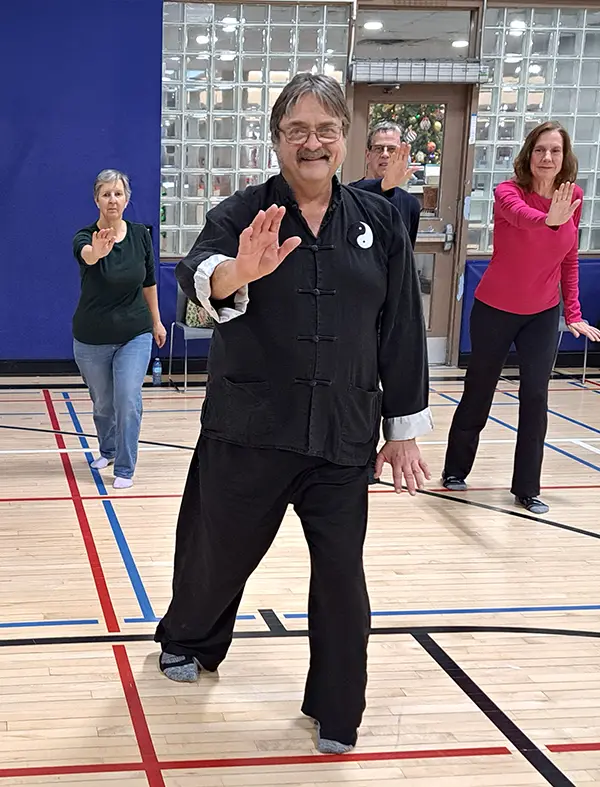
Tai Chi has been practised for over four centuries.
Tai Chi classes in Oshawa and Whitby help reduce stress by relaxing the mind, muscles and joints. When the body relaxes, energy, known as Chi, flows more freely. Students often notice improved balance, flexibility and circulation. With steady practice, mental clarity and confidence increase.
Free classes available. Beginners welcome.
At Chathamson School of Tai Chi, instruction follows traditional Chinese principles. Movements are taught slowly and with precision. Rather than meeting force with force, Tai Chi redirects incoming energy. Students develop coordination, stability and awareness through consistent practice in a respectful learning environment.

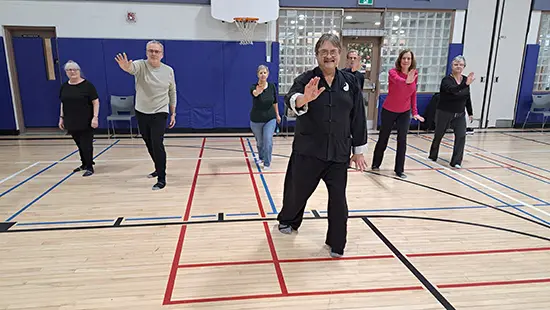
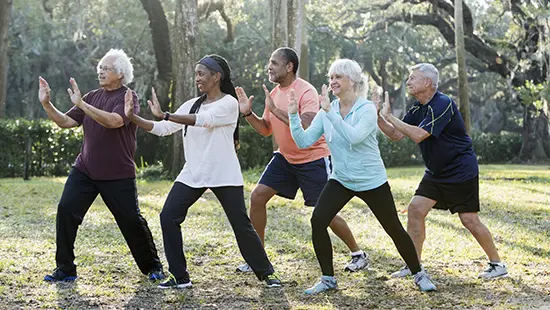
Tai Chi classes focus on controlled, flowing movements that build internal strength and balance. Each posture develops coordination, stability and breath control. Students practise with steady precision and awareness. With consistent training, confidence and physical control increase.

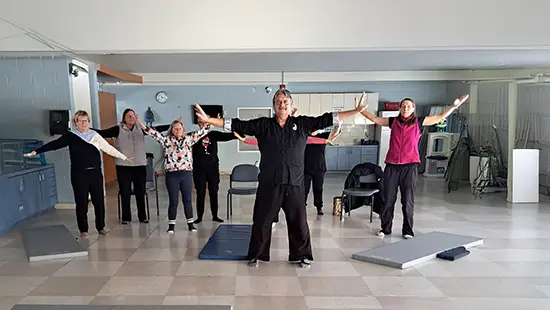
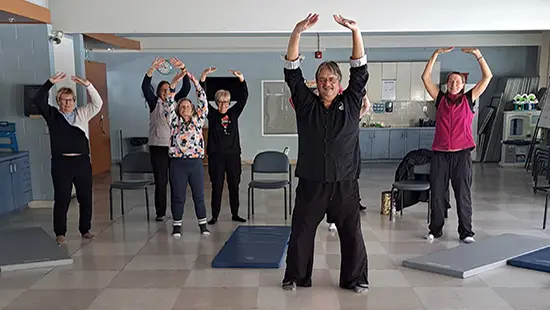
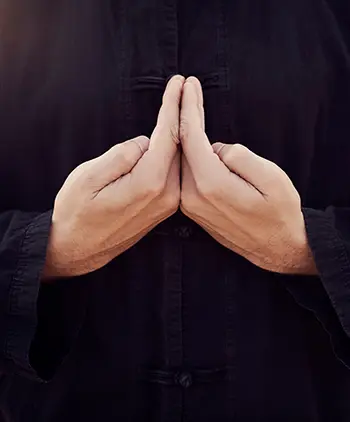
Qigong, often called Chinese yoga, emphasizes breathing, stretching and gentle movement. Each exercise supports relaxation and internal energy flow. Students learn to calm the nervous system and reduce muscular tension. With regular practice, mobility and circulation improve.

Tai Chi is both a health practice and a martial art. Each movement contains elements of offence and defence. Students learn how to redirect incoming force rather than resist it directly. Like water, Tai Chi adapts and moves around obstacles with control and awareness.

Free Tai Chi classes are offered in Oshawa at Unifor Local 222. Online Qigong sessions are also available on Wednesdays at 7:30 p.m. Instruction is structured, supportive and accessible to all levels. Beginners can join comfortably and progress at a steady pace with consistent guidance.
Class and Program Fees for Tai Chi Classes in Oshawa and Whitby
Classes are $20 per 60-minute session or $60 per month.
Community centre sessions are offered at $52 for a 9-week term.
Free Tai Chi community classes are available in Oshawa (see above).
Many students begin Tai Chi seeking relief from stiffness, poor balance or stress. With regular practice, improvements are often seen in mobility, coordination and circulation.
One student who struggled with back pain for years reported complete relief after consistent training. Another noticed improved circulation in his hands and feet after only a few classes. While results vary, steady practice produces measurable progress.
Greg Gardiner, Back Pain Resolution
Greg had been having back problems since he was a teenager. He started Tai Chi when he was 31, and after one year, his back pain completely disappeared.
Jim Doucette, Improved Circulation
After just two classes, he noticed improved circulation in his hands and feet, which had been cold for many years.
Nancy Mead, Asthma Relief
After suffering from severe asthma for six years and relying on three prescription medications costing $200 per month, she began Tai Chi. Shortly after starting, she no longer needed medication, crediting the breathing exercises practised in class.

Serving Oshawa and Whitby with traditional Tai Chi training.
Dave Chatham is a 6th-level Tai Chi Master, National Wushu judge and coach. He trained under Stewart Liem, who studied privately in China with Li Tanji, Deputy Secretary General of China’s Martial Arts Association.
In addition to leading Tai Chi classes in Oshawa and Whitby, Dave taught at Durham College for over a decade, where he was awarded a Certificate of Teaching Excellence for outstanding teacher prowess in Continuous Learning.
Dave brings decades of instructional experience to Chathamson School of Tai Chi. His teaching emphasizes relaxation before strength and awareness before reaction. Students are guided with patience, clarity and respect for traditional training methods. The focus is steady progress through disciplined, consistent practice.





Three and one-half years ago, an MS exacerbation paralyzed my right arm and hand, encased my body from the waist up in what felt like millions of prickly thorns, and took away my sense of balance so I could neither focus nor walk properly, speak or move. There were also bladder and bowel problems, assorted aches, muscle spasms, excruciating tooth pain and black depression.
In six months, the effects of the attack had lessened enough that I was motivated to seek out self-therapies. The one that has proven most beneficial has been Tai Chi Chuan.
When I first began, instructor Dave Chatham kept me practising Chi Kung, which complemented the meditation techniques I had been learning from Dr. John Hunchak. The gentle Chi Kung exercises increased my muscle mobility, eliminated many aches and pains, and taught me to focus my energies, both physical and mental. This resulted in better stress management and reduced the severity of many of my MS symptoms.
MS is such a fickle disease that it would be risky for me to claim that it helps specific problems like bladder and bowel spasms, blurred vision, etc. However, there are a few claims that I feel secure in making. I have been taught to use Chi Kung to do the following:
• Rid myself of headaches
• Work out neck pain, upper, middle and lower back pain, and sciatica
None of these conditions has ever been successfully treated by mainstream medicine, physiotherapy or chiropractic. Learning Tai Chi movements requires a certain amount of balance, coordination and concentration — elements which are deficient in most people. I know that with MS, I have improved in all of these areas.
The feeling of overall well-being that is experienced after an hour of Tai Chi is quite remarkable. Muscles and joints are loose and flexible, inner organs seem balanced and rested, and that deep, innermost part that is “me” (the “soul,” if you will) is at peace.
No experience is needed. Beginners are welcome in all classes.
Comfortable clothing that allows free movement and flat supportive footwear or socks.
Yes. Many students attend to improve balance, flexibility and coordination.
Yes. Qigong focuses more on breathing and internal energy development, while Tai Chi includes structured movement patterns and martial applications.
Classes are held in Oshawa, Whitby and online via Zoom.
Yes, one needs to book ahead. Please contact David by phone, email or use the form below.
About four years ago, I started to get pain in my right shoulder. I wasn’t too concerned, as it had been dislocated and repaired thirty-three years ago. This was caused by a sports accident. Therapy in those days was kind. “That’s fixed it, just be easy on it for a couple of months,” said the therapist. This seemed to have worked but, unknowingly, I was slowly losing my range of motion. Last year, the pain was such that I paid a visit to a doctor, who, after examination and X-ray, found that I had osteoarthritis in my shoulder.
He suggested light exercise and I visited a sports clinic where I went through a program of stretching and shoulder manipulation for three months. This greatly improved my range of motion, but I still got soreness after any sudden movement of that arm. Last fall, I signed up for a course of Qigong (Chi Kung), probably out of curiosity more than anything else. However, after three or four sessions, my shoulder wasn’t getting as sore anymore. I am now coming to the end of a second ten-week course and my range is as good as it ever was. Probably not as good as it could be, but so good that I can play table tennis for two to three hours with no ill effects whatsoever. I attribute this to the exercises in Qigong and would definitely keep on practising this form of exercise.